

 English
 Español
 عربى
Introduction to PETG Decorative Film In the realm of modern decorative materials, PETG decorative fi...
READ MORE3D Laminates: How Printed Decorative Films Hold Embossed Grain After Forming
A cabinet door with a cathedral arch and a grain line that sinks two millimetres below the surface tells you most of what matters about 3D laminates. That door is not wrapped in a flat printed sheet. It is wrapped in a film that was printed first, embossed second, and then stretched over a shaped core in a membrane press at roughly 120 to 140 °C, and it still had to keep its ink and its texture lined up afterwards.
So here is the short answer before the detail: a 3D laminate is a printed decorative film plus a matched embossing tool, engineered to hold registration and surface integrity through thermoforming. The print carries the colour and the grain pattern; the emboss carries depth, matte-to-gloss variation and hand feel. If a supplier cannot quote a registration tolerance and a usable stretch range, a flat swatch tells you very little about what will happen on your press.
What 3D Laminate Actually Describes
The phrase gets used for two different things, and mixing them up costs money at the quotation stage. One is a surface property. The other is a process. Most real projects are both at once.
Surface texture in three dimensions
In this sense the laminate has an embossed surface with measurable depth, usually 0.05 to 0.35 mm on a film of 0.12 to 0.50 mm, created by a textured roller or a release paper pressed into the coating while it is still soft. Deep cathedral grains, brushed metal lines and leather pebble patterns all belong here. Depth decides how the panel reads under grazing light: a 0.1 mm grain disappears in a dim room, while a 0.3 mm grain still casts its own shadow.
Forming over a three-dimensional shape
The second sense is the process itself. A profiled MDF door, a radiused edge, a curved wall panel: the film is heated until pliable, drawn down over the substrate by vacuum, and bonded with adhesive. Here "3D" describes the geometry being laminated rather than the film texture. This is where elongation limits, adhesive choice and cycle time start to matter more than the pattern catalogue.
Where 3D Laminates Earn Their Extra Cost
Thermoformed lamination costs more than flat lamination. There is tooling, a slower cycle, and typically higher scrap in the first weeks of a new profile. It pays back in specific places:
- Kitchen and wardrobe doors with recessed centre panels and profiled edges, where flat film would bridge and leave visible marks.
- Cabinet fronts that must sit next to solid wood frames and match the grain direction.
- Appliance fascias and trim lines where a brushed metal texture has to run consistently in one direction.
- Shop fixtures and display cabinets, which are handled heavily and inspected closely.
- Wall and ceiling features that want a stone or terrazzo look without stone weight or thickness.
- Automotive interior trim and paint-protection applications formed over compound curves.
Surface-effect films are a good test of a converter's registration control, because the pattern is directional and any drift is immediately visible.
 Electroplated Brushed Metal Decorative Film for Surface FinishingThis brushed electroplated film simulates stainless steel, aluminum, or copper and suits flat lamination and wrapping where registration and finish are visible.View Product →
How Print and Texture Stay in Register
Three production steps decide whether the finished panel looks like wood or like a photograph of wood.
Printing comes first. Water-based inks are laid down on the film in the target pattern, whether that is a grain, a stone vein or a woven fabric. Water-based systems are chosen for low odour and lower solvent load, which matters when the laminated panel ends up in a bedroom or a hospital corridor.
Registration comes second, and this is the step buyers underestimate. The embossing roller's pattern must be positioned against the print repeat so that dark grain lines land in the valleys and not on the ridges. Get this wrong by a few millimetres and the material reads as printed plastic from two metres away.
Coating comes last. A thin functional topcoat adds scratch and stain resistance without filling the texture. The number to ask about is registration tolerance: plus or minus 0.5 mm is achievable on a stable repeat, while plus or minus 2 mm is where woodgrain stops looking like wood. Forming then compounds the error, because stretching 40 percent over a door edge multiplies any misalignment already present in the flat film.
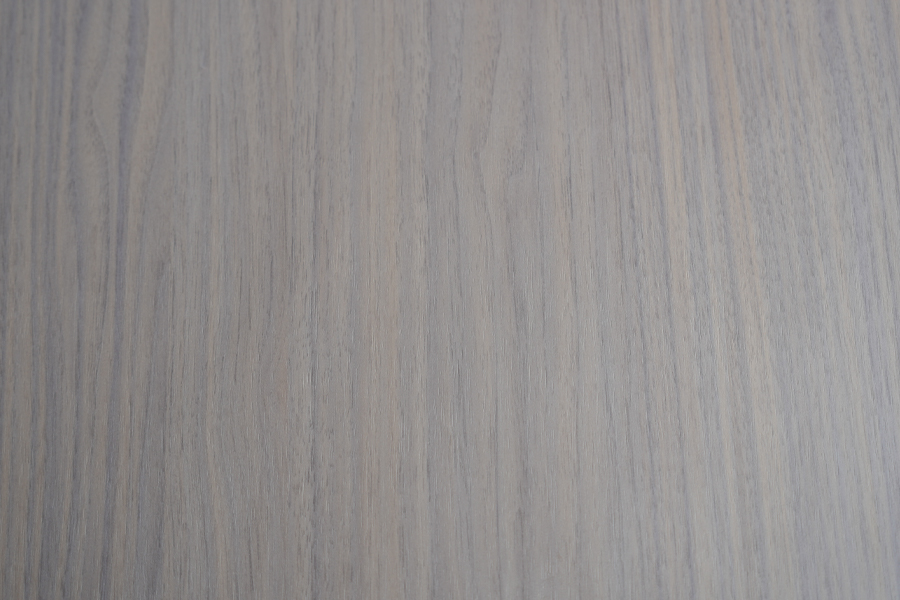 Dark Wood-Grain PVC Printed Decorative FilmWater-based printed PVC film for lamination, wrapping, and thermoforming; its woodgrain pattern makes registration tolerance and forming behavior critical to inspect.View Product →
Choosing the Film: PVC, PETG and PET
All three families will form, but they behave differently under heat and they age differently on the panel.
| Film | Typical thickness | Forming behaviour | Best suited to | Main risk |
|---|---|---|---|---|
| PVC decorative film | 0.12 to 0.50 mm | Forms at relatively low temperature with high elongation, forgiving on tight radii | Woodgrain, fabric, leather, stone and single-colour furniture surfaces | Gloss drift or plasticiser migration if the topcoat is weak |
| PETG decorative film | 0.20 to 0.60 mm | Needs a higher and narrower forming window, less stretch before stress marks appear | Matte cabinet door panels, solid-colour fronts, visible edges | Stress whitening at sharp corners when the press runs too cool |
| PET film | 0.10 to 0.30 mm | Low stretch, normally applied to gentle curves or flat surfaces | Paint protection and lightly curved exterior parts | Coating or print cracking when over-stretched |
For cabinet doors, PETG has become the more common choice where a matte, low-gloss finish and a solid edge are wanted, because the material is stiffer and holds a flat face without telegraphing the substrate. The trade-off is process discipline: a PETG run needs a tighter temperature band and a slower draw than PVC, and operators used to PVC usually need a few shifts to adjust.
The wider material behaviour of PETG films is worth reading before specifying a profile.
PETG decorative film behaviour and applications covers where the material holds up best.
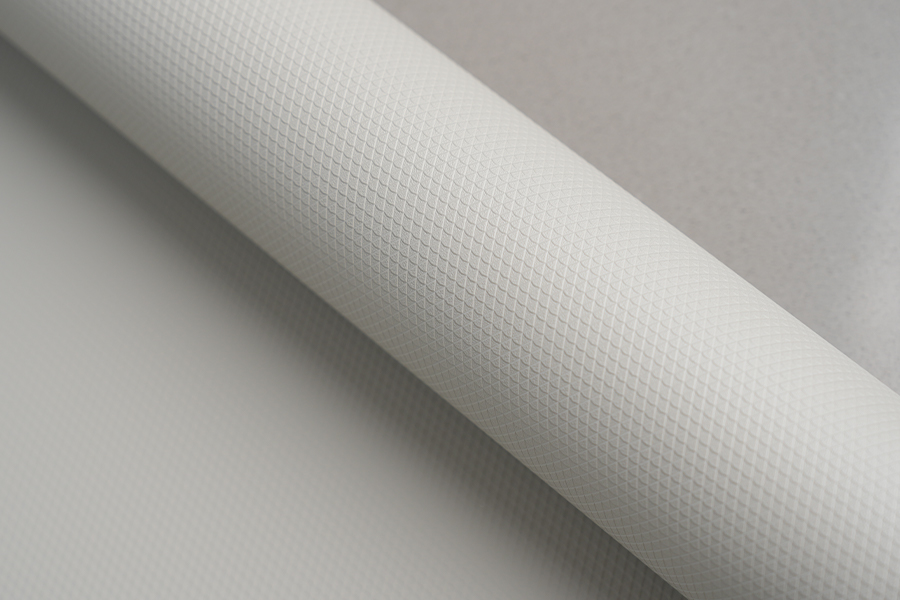 Solid Color Matte PETG Decorative Film for Cabinet DoorsMatte PETG film for flat lamination and wrapping on cabinet doors, where exact thickness and width help ensure consistent processing results.View Product →
Specifications Worth Writing Into the Purchase Order
Vague specifications are the most common reason a first container passes inspection and the second one does not. Put numbers on these points:
- Film thickness and its tolerance, expressed in millimetres rather than "standard".
- Emboss depth and pattern repeat length, so a replacement roll can be matched.
- Registration tolerance in the flat state, and the acceptable drift after forming.
- Forming window: recommended temperature range, dwell time and vacuum level.
- Elongation at break, and the maximum stretch the print survives without cracking.
- Adhesion, verified by cross-hatch test with a stated classification.
- Gloss level in gloss units at 60 degrees, plus the permitted deviation.
- Colour consistency, typically a colour difference no greater than 1.0 between batches.
- Stain, heat and household chemical resistance, with the test method named.
Failure Modes to Screen for Before a Full Run
Most problems that reach a production line were already visible in a formed sample. Ask for a sample pressed over your own profile, not a flat swatch.
- Misregistration after forming: check grain line position at the deepest draw point, not the flat centre.
- Whitening at tight radii: usually excess stretch or a press temperature that is too low.
- Edge delamination: often adhesive selection, substrate dust or an unsealed edge rather than the film.
- Print cracking in cold weather: compare elongation data against the actual draw ratio.
- Gloss drift between batches: a film that looks identical in a sample book can still shift by several gloss units.
- Blistering on MDF cores: moisture in the board, not the adhesive, is the usual cause.
Settling the Details Before the First Container
Three questions separate a supplier who understands 3D laminates from one who only sells printed roll stock: what registration tolerance do you hold, what stretch does the print survive, and can you send a formed sample over my profile? A producer with in-house water-based printing, registered lamination and functional coating under one roof can answer all three from its own line data, and can adjust a repeat or a gloss level without sending the work outside.
You can review the decorative film range and request formed samples matched to your door profile before committing to volume.
PREV:No previous articleNEXT:What Is Thermofoil? Process, Materials, and Cabinet Door Applications Explained
Interested in cooperation or have questions?
Recommended articles
-

Don't hesitate to contact when you need us!
GET IN TOUCH
-
Wood-Grain PVC Printed Decorative Film
Single Color PVC Decorative Film
Time-Space Fantasy PVC Printed Decorative Film
Cloth-Grain PVC Printed Decorative Film
Faux Leather Texture PVC Decorative Film
-
 No. 2 Yidu Road, Yizhuang Village, Guanlin Town, Yixing , Jiangsu, China.
 +86-0510-80773188
+86-18020301786 -

Copyright © Wuxi Telisi New
Material Technology Co., Ltd. Rights Reserved.
PVC Decorative Film Manufacturers PVC Membrane Foil Suppliers
