

 English
 Español
 عربى
Introduction to PETG Decorative Film In the realm of modern decorative materials, PETG decorative fi...
READ MOREadhesive for pvc to wood: Applications, Selection Criteria, and Practical Guidance
A cabinet door with a 0.35 mm woodgrain PVC film laminated to an MDF core can look flawless the day it leaves the press, then lift along one edge six weeks later in a warm showroom. The adhesive usually takes the blame, but in most cases it was asked to do a job it was never formulated for: bond a plasticized vinyl face to a porous, moisture-variable wood substrate and hold through a 60 °C summer.
Here is the short answer before the detail. For rigid and semi-rigid PVC decorative films on MDF, plywood or particleboard, a crosslinking water-based VAE/PVA adhesive or a PUR reactive hot melt gives the best balance of strength, heat resistance and process safety. Solvent-based contact adhesive remains the fastest route and still suits thick, heavily plasticized films and on-site work, but it softens earlier under heat and must be chosen with plasticizer attack in mind. Two-part epoxy belongs on structural or permanently wet joints, not on thin film lamination.
Two Surfaces That Behave Nothing Alike
Wood is porous, polar and dimensionally alive. Rigid PVC is smooth, non-porous and low in surface energy, roughly 38 to 40 mN/m, which sits close to the point where a water-based adhesive stops wetting out properly. A drop that beads on the vinyl back is a warning: no amount of clamp pressure will recover a bond that never made contact at the molecular level.
Flexible PVC adds a second problem. Plasticizer migrates slowly toward the interface, forming a weak boundary layer, and a stiff glue line then peels away cleanly while the film itself stays intact. That is why a joint can pass a peel test on day one and fail at month three.
Third comes movement. A PVC film expands and contracts several times more per degree of temperature change than the wood beneath it. The adhesive has to stay flexible enough to absorb that shear, yet firm enough not to creep under a stack of doors in a warm warehouse. Water-based systems and PUR sit in that window; soft EVA hot melts generally do not.
Adhesive Families Side by Side
| Adhesive | Typical use | Heat resistance | Plasticizer tolerance | Watch out for |
|---|---|---|---|---|
| Crosslinking water-based VAE/PVA | MDF, plywood and particleboard with rigid film | Moderate, up to about 70 °C with crosslinker | Good | Needs press time and an absorbent face |
| Solvent-based contact (polychloroprene) | Thick flexible film, curved panels, site repair | Low to moderate, softens above roughly 60 °C | Moderate | VOCs, flammability, short and fussy open time |
| PUR reactive hot melt | Production lines, flat panels, edge wrapping | High, above 100 °C | Very good | Moisture cure, brief open time, equipment cost |
| EVA hot melt | Edge banding and low-stress trim | Low, around 50 to 60 °C | Poor | Creeps under load and heat |
| Two-part polyurethane | Humid or exterior service, thick PVC | High | Good | Mixing discipline, pot life, cost per square meter |
| Two-part epoxy | Structural and waterproof joints | High | Good | Rigid glue line, telegraphing, no give for film movement |
| Cyanoacrylate | Small repairs and jigs | Low | Poor | Brittle, never for flat panel work |
| Acrylic pressure-sensitive | Pre-coated film, short runs, flat faces | Low to moderate | Varies by grade | Trapped air and edge lift in heat |
Read the Film Before You Read the Adhesive Label
Three film properties change the answer more than any glue datasheet will.
- Plasticizer content. Rigid and semi-rigid decorative grades are far easier to bond than soft, heavily plasticized sheet, which pushes you toward PUR or a two-part polyurethane.
- Thickness and stiffness. A 0.2 mm film follows a substrate; a 0.5 mm film fights it, and the glue line has to hold that stored stress.
- Back-side treatment. Corona, plasma or a primer on the reverse face can lift peel strength considerably on an otherwise difficult vinyl surface.
One practical note: the printed, coated face of a decorative film is not a bonding surface. Adhesive goes on the reverse only, and any handling oil, release agent or dust on that reverse face should be assumed guilty until proven otherwise.
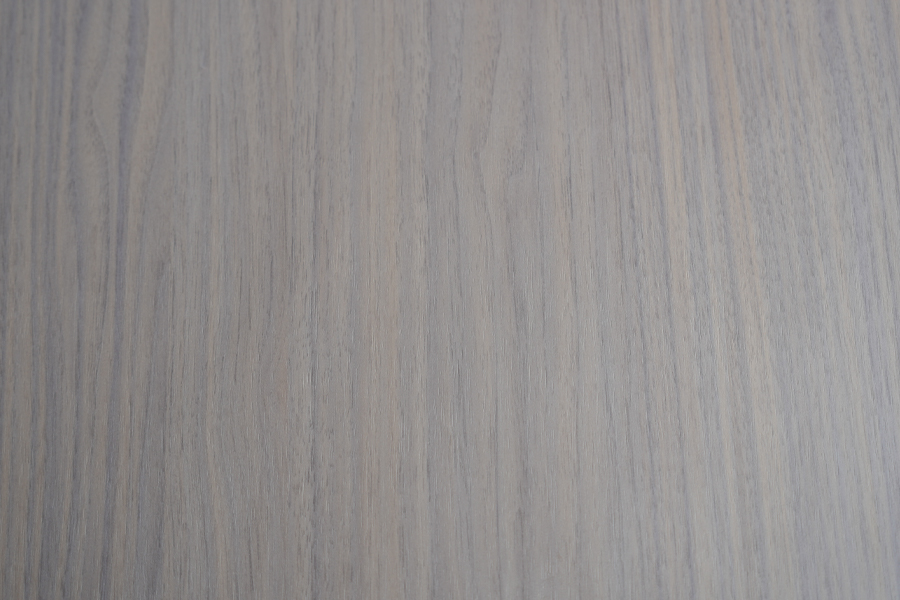 Dark Wood-Grain PVC Printed Decorative FilmDark wood-grain PVC film for flat lamination, wrapping and thermoforming, with scratch- and stain-resistant surface; relevant where reverse-face cleanliness and timber moisture control affect bonding.View Product →
The Wood Side Decides the Other Half
Timber should sit at 6 to 8 percent moisture content before lamination. A board that drifts two points after bonding will move enough to shear a thin glue line, and no adhesive on the market compensates for that.
Species matters. High-tannin woods such as oak and ash, and oily species such as teak or ipe, release extractives that can slow or block the cure of water-based and epoxy systems. A thin sealer coat on those faces is cheaper than rework. Highly absorbent MDF and particleboard cause the opposite problem: they drink the water-based adhesive and starve the interface, so spread rate has to go up rather than down.
Sanding is the third lever. A 100 to 120 grit finish leaves a mechanical key; polishing to 180 grit or finer burnishes the surface and closes the pores. Vacuum or brush off dust within the hour, because a contaminated face is the most common cause of a bond that pulls away with no residue on the wood at all.
Process Parameters That Actually Move the Needle
- Spread rate: 120 to 180 g/m² for crosslinking water-based adhesive on one face; 150 to 200 g/m² per face for contact adhesive.
- Assembly window: keep parts inside the adhesive's open time, and never let a contact adhesive go from tacky to dry before closing.
- Pressure: 0.3 to 0.6 MPa in a flat press, or a roller at 3 to 5 bar for continuous lines, applied evenly from the center outward.
- Environment: workshop above 15 °C and adhesive conditioned above 18 °C. Cold adhesive films, cold boards and cold presses all shorten open time unpredictably.
- Cure schedule: 30 to 60 minutes under clamp, 24 hours before trimming, and 72 hours before the panel meets a heat source or a stack load.
Test Before You Run a Thousand Doors
Build three specimens from the actual board and film batch, then run them through this sequence.
- 90 degree peel after 24 hours, on a strip at least 25 mm wide, pulled at a steady rate.
- Cross-hatch tape pull on a small area, judged by how much film remains after the tape lifts.
- Heat cycle: 70 °C for 4 hours, cool to room temperature, then inspect edges for lift or curl.
- Water soak for 24 hours on an offcut, followed by a re-peel while the joint is still damp.
- Edge-of-panel test at 50 °C and 80 percent relative humidity for 48 hours, which is where most real failures appear first.
Write the pass thresholds down before testing. A result you cannot compare against a number is not a result.
Reading a Failure: Symptom, Cause, Fix
- Clean peel with a bare wood face: adhesive starvation on MDF, or dust left on the board. Raise spread rate and add dust extraction.
- Edge lifting after warm storage: glue line too stiff, or spread too low at the perimeter. Increase coverage at edges and consider PUR.
- Blisters and bubbles: trapped solvent or moisture. Extend flash-off time and check board moisture before pressing.
- Gummy residue on the film: plasticizer migration attacking a solvent-borne glue line. Move to PUR or two-part polyurethane.
- Visible grain telegraphing through the film: glue line too thin or press pressure too low for the film thickness in use.
Choosing the Film Side of the Bond
Rigid, unplasticized PVC decorative film is the most forgiving partner for any of the systems above. PETG behaves similarly in bonding terms while offering better environmental credentials, and its rigid structure means less plasticizer migration to plan around; the properties and applications of PETG decorative film are worth reviewing if cabinet doors are your main output.
For flat panel work, a matte solid color grade keeps the bond simple because there is no deep embossing to trap air or adhesive voids.
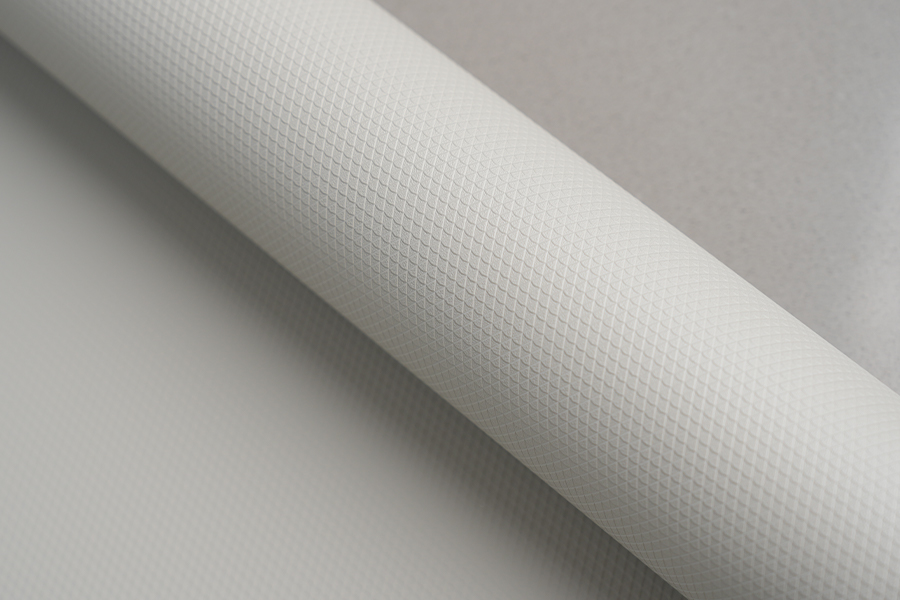 Matte Solid-Color PETG Cabinet Door Decorative FilmMatte solid-color PETG film for cabinet door panels and flat lamination or wrapping, suited to simple flat-panel bonds without deep embossing that can trap air.View Product →
Stone-effect films behave like other rigid PVC grades but hide edge lifting poorly, since a white marble face shows any shadow line at the perimeter; those panels deserve extra attention at the trimming stage.
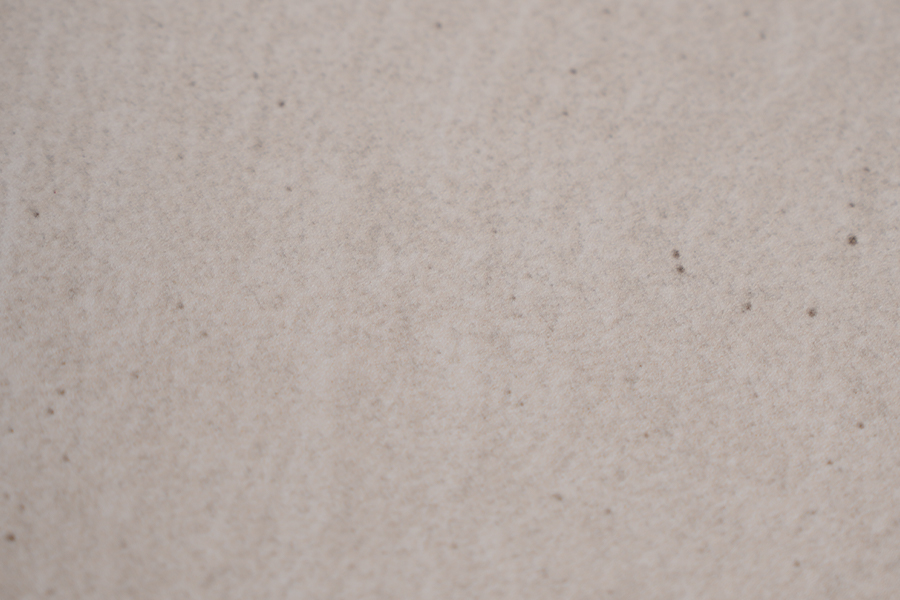 Jazz White Marble PVC Decorative Printing FilmMarble-look PVC film for flat lamination, wrapping and blistering; useful for interior surfaces where trimming attention matters because pale stone faces can reveal edge lift.View Product →
Where the design calls for timber looks across doors, panels and furniture frames, matching the woodgrain PVC printed decorative film range to one adhesive specification keeps press settings and cure schedules consistent across the whole production run.
What Belongs on the Specification Sheet
One adhesive name is not a specification. Record the adhesive family and grade, spread rate, press pressure and time, board moisture content at bonding, workshop temperature, and the pass threshold for your heat cycle test. Hand that sheet to the line, not to a drawer.
Get those variables fixed and the adhesive for PVC to wood stops being a guessing game. Most failures people attribute to glue are, in the end, a moisture reading nobody took, a spread rate nobody measured, or a plasticizer that was never accounted for in the first place.
PREV:No previous articleNEXT:3D Laminates: How Printed Decorative Films Hold Embossed Grain After Forming
Interested in cooperation or have questions?
Recommended articles
-

Don't hesitate to contact when you need us!
GET IN TOUCH
-
Wood-Grain PVC Printed Decorative Film
Single Color PVC Decorative Film
Time-Space Fantasy PVC Printed Decorative Film
Cloth-Grain PVC Printed Decorative Film
Faux Leather Texture PVC Decorative Film
-
 No. 2 Yidu Road, Yizhuang Village, Guanlin Town, Yixing , Jiangsu, China.
 +86-0510-80773188
+86-18020301786 -

Copyright © Wuxi Telisi New
Material Technology Co., Ltd. Rights Reserved.
PVC Decorative Film Manufacturers PVC Membrane Foil Suppliers
