

 English
 Español
 عربى
Introduction to PETG Decorative Film In the realm of modern decorative materials, PETG decorative fi...
READ MOREComo laminar MDF: substrate prep, film choice, press settings, edge sealing
How to Laminate MDF: The Short Answer
Laminating MDF is a flat-panel process, not a decorative afterthought. The reliable sequence is: condition the board, confirm flatness and moisture content, seal the edges, select a compatible film and adhesive, apply uniform heat or pressure, let the panel cure, then trim and edge-band. Most failures come from moisture, uneven pressure, insufficient adhesive, or trimming too soon. The Spanish query "como laminar mdf" usually comes from the same workshop problem: how to get a consistent surface without bubbles, edge lift, or wavy faces.
For furniture and cabinet production, the practical target is a panel that stays flat after cooling, holds a clean edge, and survives normal cleaning. The film is only one part of that result. Substrate preparation and press control decide whether the finished panel looks factory-made or repaired.
Why MDF Needs a Different Lamination Routine
MDF is uniform and has no grain, which makes it good for routered shapes and flat doors. It is also hygroscopic and has porous, thirsty edges. A film that bonds well to a sealed face can still lift at an unsealed edge after a few weeks in a humid room. The face can telegraph sanding scratches, dust, and adhesive lumps, especially with thin decorative films.
Before lamination, aim for a clean, stable board. A common workshop target is 7-9% moisture content, checked with a meter at several points. Store boards flat in the same room as the press for at least 24 hours. Sand with 180-240 grit to remove glaze and handling marks, then dust-extract. Do not over-sand edges until they become fuzzy. Prime or seal cut edges with a compatible edge sealer, and keep the panel flat while it dries.
Flatness matters as much as smoothness. A board with a slight bow can be pulled flat by a stiff film, then spring back after trimming. Check with a straightedge across the face and along the diagonal. If the MDF has been stored on edge or near a damp wall, reject it rather than trying to press the problem away.
Choose the Decorative Film Before You Set the Press
MDF can be laminated with melamine paper, veneer, PVC film, PET film, PETG film, or paint systems. For furniture, cabinets, and interior panels, decorative films are popular because they combine a printed or solid color surface with a repeatable bond. The choice should follow the use case, not just the sample book.
PVC printed films are widely used for woodgrain furniture, shelving, and wall panels. A light woodgrain PVC printed decorative film can reproduce oak, ash, or maple tones while keeping the substrate stable and the surface easy to clean. Darker designs are also available, but dark colors show dust and scratches more readily, so handle panels with clean gloves and protect them during transport.
 Light-Colored Wood-Grain PVC Printed Decorative FilmA wood-look PVC film for furniture and panels, using water-based printing and treated for scratch, stain, corrosion, and heat resistance; suits light woodgrain finishes.View Product →
PETG decorative film is a better fit when cabinet doors need a matte, solid-color finish with good visual depth. It is often used for handleless kitchen fronts, wardrobe doors, and retail fixtures. The advantages and applications of PETG decorative film include a smooth surface and a more premium look than a standard low-pressure laminate, provided the adhesive and press cycle are matched to the film.
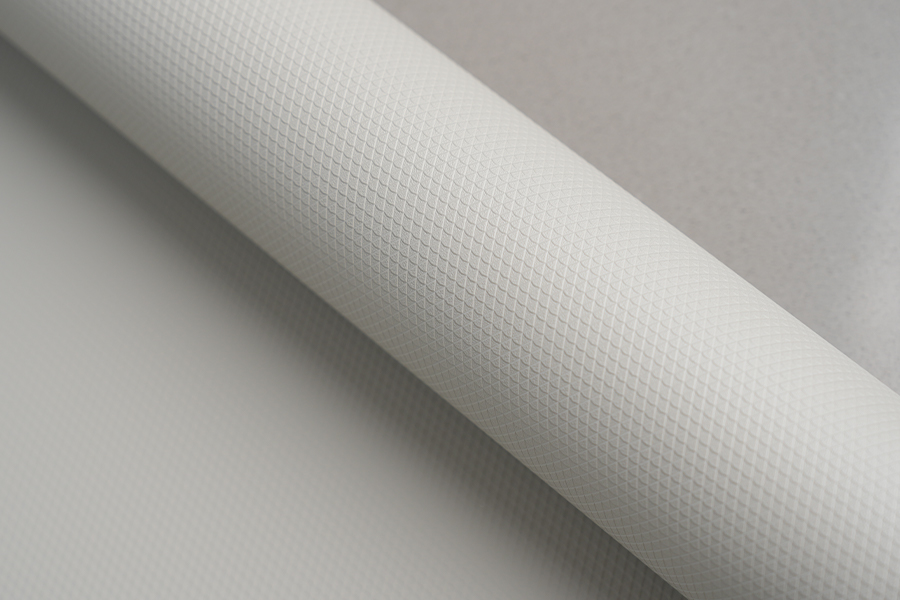 Solid Color Matte PETG Decorative Film for Cabinet DoorsA matte PETG film for cabinet door panels and wrapping, described as recyclable and scratch-resistant for kitchen, bathroom, and office surfaces.View Product →
Stone and marble effects are useful for tabletops, display counters, and wall panels where the design calls for a harder visual texture without solid stone weight. A Jazz White marble PVC printed decorative film can be pressed onto MDF for cabinet fronts and feature panels, but the edges need careful sealing because the light face shows adhesive bleed and dirt more easily.
 Jazz White Marble PVC Printed Decorative FilmA lightweight self-adhesive marble-look PVC film with water-based printing and scratch, stain, and corrosion resistance for furniture, walls, countertops, and cabinets.View Product →
For a broader comparison of PETG films and their applications, review the PETG decorative film category, but confirm the exact surface, gloss level, and backing with the supplier before ordering a production run.
Step-by-Step: Laminating MDF with Decorative Film
1. Condition and prepare the substrate
Bring MDF and film into the same climate-controlled area. Twenty-four hours is a minimum for stable board; thicker panels may need longer. Check moisture, flatness, and surface contamination. Sand, dust-extract, and seal edges. If the panel will be routed after lamination, seal the routed edge again before edge-banding or top-coating.
2. Match adhesive to film and press method
Use an adhesive system recommended for the film, not a generic contact glue chosen by habit. Water-based PU dispersion, hot-melt, and pressure-sensitive systems behave differently. A flat press with heat and pressure needs an adhesive with the right activation window. A cold roller line needs enough open time and consistent nip pressure. Spread rate should follow the adhesive supplier's coverage figure; too little adhesive causes edge lift, while too much can create orange-peel texture and trapped solvent.
3. Lay up in a dust-free zone
Place the MDF on a clean, flat carrier. Align the film without stretching it. For thin films, a tack roller or squeeze roller helps remove air from the center outward. Do not let the film fold back onto itself; a crease can become a permanent mark after pressing. Keep the room free of airborne dust, because particles under a thin film telegraph through the surface.
4. Press with uniform heat and pressure
Follow the film supplier's press window. Flat presses typically run at moderate temperature with enough pressure to wet out the adhesive without crushing the MDF edge. Check the press platen for flatness and clean any adhesive residue. Panels that are pressed too cool or too fast may look bonded but fail a peel test after cooling.
5. Cool, trim, and seal edges
Let the panel cool flat before trimming. Trimming while the adhesive is still soft can pull the film back from the edge. Use a sharp flush-trim bit or guillotine set to the panel thickness. Edge-band or seal the cut edge within the same production window. For wet areas, specify a moisture-resistant edge treatment rather than relying on the film alone.
Lamination Methods Compared
| Method | Best for | Main watch-outs |
|---|---|---|
| Cold roller | Flat panels, woodgrain PVC, medium-volume runs | Nip pressure and dust control; air entrapment on wide panels |
| Flat press | PETG and high-gloss or matte cabinet doors | Temperature uniformity; platen marks; adhesive activation |
| Vacuum press | Shaped or routed MDF, small batches | Membrane marks; slow cycle; edge pressure on deep profiles |
| Contact adhesive | Site work, repairs, low-volume custom pieces | Solvent smell; uneven spread; immediate grab with little repositioning |
In a factory, the method should be selected with the film thickness and adhesive in mind. A process that works for a 0.18 mm PVC film may fail with a thicker PETG film or a high-gloss surface. Run a small panel first, cool it, and test adhesion and appearance before releasing the batch.
Quality Checks That Catch Problems Early
Check every batch after cooling, not immediately after pressing. A panel that looks perfect hot can show bubbles or edge lift once the adhesive sets. A practical inspection routine includes:
- Visual scan under raking light for bubbles, dust, scratches, and adhesive bleed.
- Edge check with a fingernail or tape pull at corners; any lift needs investigation.
- Flatness check with a straightedge after trimming and again after 24 hours.
- Peel or cross-hatch adhesion test on a sample from the same film lot.
- Heat and moisture check if the panel will be used near kitchens, bathrooms, or windows.
Telegraphing is a common MDF issue: sanding marks, dust, or adhesive lumps show through thin films. If the surface looks wavy but the film is bonded, the problem is usually substrate preparation or press pressure, not the film. Silvering or a cloudy look can point to trapped air or insufficient adhesive wet-out.
Procurement Details That Affect Yield and Rework
For a furniture producer, the lowest-cost film is not always the lowest-cost lamination. Ask for the film caliper, roll width, roll length, color lot, release liner, and recommended press window. A 0.12 mm film may follow a slightly rough MDF face, but it can also show more texture. A thicker film hides more substrate variation but needs more heat or pressure to conform.
Scratch resistance, stain resistance, and heat resistance should be matched to the final use. Cabinet doors near a hob need better heat resistance than wardrobe doors. Retail fixtures need a surface that can be cleaned often without dulling. For exterior or humid applications, do not rely on standard interior MDF and a decorative film alone; specify a moisture-resistant board and a sealed edge system.
Order film and adhesive as a matched system when possible. Color consistency across lots matters on visible door runs, and a small shade shift can force a rework of an entire batch. Keep a retained sample from each lot, record the press cycle, and label panels with the film lot and adhesive batch. That record shortens the diagnosis when an edge lifts or a surface mark appears.
Common Mistakes and Practical Remedies
Most MDF lamination defects are process defects, not material defects. The first mistake is skipping edge sealing; MDF edges absorb moisture and adhesive quickly, and a sealed edge is the difference between a stable panel and a lifted corner. The second is pressing a board that is not flat. A bowed board can be forced flat in the press, but the stress remains in the panel.
Dust is another frequent cause. A single shaving under a thin film can create a visible bump that cannot be pressed out. Clean the carrier, the platen, and the panel immediately before layup. Finally, do not trim too early. Let the adhesive cool and the panel relax, then trim with a sharp tool and seal the edge. If a batch fails, isolate the cause by checking substrate moisture, adhesive spread, press temperature, and film lot in that order.
A repeatable MDF lamination process is built around stable substrate, matched film and adhesive, controlled pressure, and sealed edges. When those four points are documented, a furniture or cabinet operation can change colors and textures without changing the fundamentals of the line. That is also the practical answer to "como laminar mdf" for production teams: control the panel before you decorate it.
PREV:No previous articleNEXT:Car Interior Wood Grain Vinyl Wrap: Choosing, Fitting and Sourcing the Right Film
Interested in cooperation or have questions?
Recommended articles
-

Don't hesitate to contact when you need us!
GET IN TOUCH
-
Wood-Grain PVC Printed Decorative Film
Single Color PVC Decorative Film
Time-Space Fantasy PVC Printed Decorative Film
Cloth-Grain PVC Printed Decorative Film
Faux Leather Texture PVC Decorative Film
-
 No. 2 Yidu Road, Yizhuang Village, Guanlin Town, Yixing , Jiangsu, China.
 +86-0510-80773188
+86-18020301786 -

Copyright © Wuxi Telisi New
Material Technology Co., Ltd. Rights Reserved.
PVC Decorative Film Manufacturers PVC Membrane Foil Suppliers
